

For many, the mention of Machu Picchu conjures images of the classic stone paths of the Inca Trail. However, for the modern adventurer seeking a more rugged, diverse, and permit-flexible experience, the Salkantay Trek has emerged as the premier alternative. Named by National Geographic Adventure as one of the 25 best treks in the world, the Salkantay route is an ecological kaleidoscope that transports you from the frozen heights of the Andes to the humid depths of the high jungle.
Spanning roughly 74 kilometers (46 miles) over five days, this journey is not just a path to an ancient citadel; it is a transformative physical and spiritual encounter with the “Apu” Salkantay, the sacred protector of the Incas. In 2026, as travel to the Cusco region continues to evolve, understanding the nuances of the trail and the intricacies of Salkantay reservations is essential for a successful expedition.
1. Why Choose the Salkantay Trek?
Unlike the Inca Trail, which is characterized by constant archaeological ruins, the Salkantay Trek is a tribute to raw nature. It is the route of choice for those who value landscape diversity and a sense of solitude. The journey begins in an alpine tundra and finishes in a tropical cloud forest. You will come face-to-face with Mount Salkantay ($6,271text{m}$), the second-highest peak in the Cusco region, and pass through local coffee plantations and remote Andean villages that remain largely untouched by mass tourism.
One of the greatest advantages of this route is its flexibility. While the Inca Trail is often booked a year in advance due to strict daily permit limits, Salkantay offers more spontaneous opportunities for exploration. However, the trek is significantly more demanding. It features a higher maximum elevation and longer daily distances, making it the preferred choice for those who enjoy a true physical challenge.
2. The 5-Day Salkantay Itinerary: From Glaciers to Jungles
Day 1: The Ascent to Humantay Lake
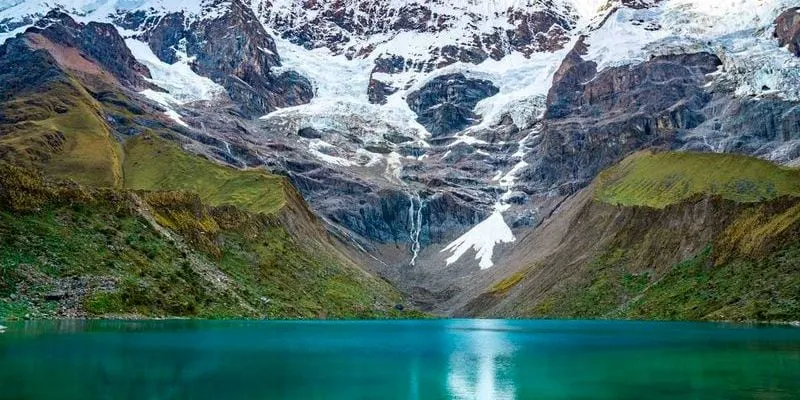
The journey typically begins in Mollepata or Challacancha. The first day is a steady climb toward Soraypampa ($3,900text{m}$), a glacial valley nestled between the snow-capped peaks of Humantay and Salkantay. The highlight of the day is an afternoon side-trip to Humantay Lake, a turquoise jewel fed by the melting glacier above. This day serves as a critical test for your acclimatization.
Day 2: The Salkantay Pass Challenge
This is the most physically demanding day of the trek. You will climb for roughly 3 to 4 hours to reach the Salkantay Pass ($4,650text{m} / 15,256text{ft}$). Standing at the “Pass of the Inca,” you are surrounded by glaciers and the profound silence of the high Andes. From here, the trail begins a dramatic 1,700-meter descent into the Chaullay cloud forest, where the cold mountain air is replaced by the warmth of the jungle.
Day 3: The Cloud Forest and Coffee Trails
The landscape shifts into the “Ceja de Selva” (the eyebrow of the jungle). You will trek through lush vegetation, spotting wild orchids, bromeliads, and colorful birds. Many hikers stop at Lucmabamba to visit local organic coffee farms. Here, you can harvest, roast, and grind your own beans, the freshest cup of coffee you will ever experience while learning about the sustainable farming practices of the Andean communities.
Day 4: Llactapata and the First Glimpse
Day four offers a unique historical treat: the climb to Llactapata. This “forgotten” Incan site sits directly across the valley from Machu Picchu. It is the only place on any trek where you can see the citadel from a distance, framed by the surrounding mountains. After descending to the Hydroelectric station, a final flat walk takes you to Aguas Calientes, the bustling town at the base of Machu Picchu.
Day 5: The Lost City of the Incas
The grand finale begins with a pre-dawn bus ride or hike to enter the gates of Machu Picchu. Following a guided tour of the stone temples and agricultural terraces, you have the option (with advance permits) to climb Huayna Picchu or Machu Picchu Mountain for an aerial perspective of the ruins.
3. Salkantay Reservations: What You Need to Know
While the Salkantay Trek is famous for its lack of “trail permits,” it is a common misconception that you can simply show up without a plan. Salkantay reservations in 2026 are multi-layered and require strategic timing.
The “No-Permit” Advantage
Unlike the Classic Inca Trail, which is capped at 500 people per day and requires a government permit months in advance, the Salkantay route itself does not have a daily hiker limit. This means you can often find a spot on a group tour just a few weeks before departure. However, the popularity of the route is growing, and high-quality operators often fill up their most comfortable lodging options quickly.
The Machu Picchu Bottleneck
Even though you don’t need a permit for the trail, you must have a reservation for Machu Picchu and the Return Train.
-
Citadel Entrance: In 2026, the Peruvian Ministry of Culture uses a strict “circuit” system. To see the classic postcard view (Circuit 2), you should book at least 3 to 4 months in advance.
-
Huayna Picchu: If you wish to hike this iconic peak, reservations are often sold out 5 to 6 months ahead. Without these reservations, you will only be able to view the ruins from the lower levels.
Accommodation Reservations
The Salkantay Trek has moved beyond basic camping. Today, you can choose from specialized glass-roofed Sky Camps in Soraypampa that allow you to sleep under the stars. These are high-demand and require booking 4 to 5 months in advance. For a luxury experience, there are high-end lodge-to-lodge treks which should be reserved 6 to 8 months out.
4. Preparing for the Trek: Difficulty and Weather
The Salkantay Trek is categorized as Challenging. It is significantly tougher than the Inca Trail due to the higher altitude of the pass ($4,650text{m}$ vs $4,215text{m}$) and the longer daily distances covered.
When to Go
-
Dry Season (April – October): The best time to trek. Days are sunny and clear, though nights at the first camp can drop below freezing ($0^circtext{C}$). June, July, and August are peak months; reservations for Machu Picchu during this time are hardest to get.
-
Shoulder Season (April/May & Sept/Oct): The “sweet spot” for fewer crowds and pleasant weather.
-
Rainy Season (November – March): Expect rain and muddy trails. February is generally avoided as the mountains are prone to landslides and many reputable agencies pause operations for maintenance and training.
Acclimatization and Training
Do not underestimate the altitude. It is a mechanical necessity to spend at least 2 to 3 days in Cusco ($3,400text{m}$) before starting the trek. This allows your body to produce more red blood cells, reducing the risk of Acute Mountain Sickness (AMS). Your physical training should focus on cardiovascular health and leg strength. Brisk walking on uneven terrain with a weighted backpack is the most effective way to prepare your muscles for the steep switchbacks of the Salkantay Pass.
5. Conclusion
The Salkantay Trek is more than a walk through the woods; it is a journey through time and climate. It demands respect for the mountains and rewards that respect with views that will stay with you for a lifetime. Whether you are drinking coffee with a local farmer or standing in the shadow of a glacier, Salkantay offers a raw, unfiltered connection to the Andes that the more manicured trails simply cannot match. If you are ready to challenge your limits and witness the true diversity of Peru, it’s time to secure your Salkantay reservations.
Key Takeaways
-
Trail Flexibility: No government trail permits are needed for the route itself, but you must secure Machu Picchu tickets months in advance.
-
Ecological Diversity: You will experience everything from glacial tundras to tropical cloud forests in just five days.
-
High Altitude: The Salkantay Pass is at $4,650text{m}$, making it higher and more difficult than the Inca Trail.
-
Preparation: Acclimatize in Cusco for 2 to 3 days and focus on leg strength and cardio before arriving.
-
Best Timing: Aim for the dry season (May to September) for clear views, but book your Machu Picchu circuits by February or March to ensure access.
